


On Monday, Governor Tim Walz of Minnesota signed bill SF 4760 into law. While it may seem rather benign and routine at first glance, this bill includes a section that makes it the first of its kind: it outlaws operating or advertising exchanges where consumers can trade event contracts.
The Bill
What exactly are they banning? The term “prediction market” is vague and could mean any number of things.1
The bill defines it as “a system that allows consumers to place a wager on the future outcome of a specified event that is not determined or affected by the performance of the parties to the contract.”
I read this clause for the first time at 6:30am on Thursday morning, and my tired brain’s first thought was “if it is affected by the performance of the parties, that means it’s fine!” Did I just find an insane loophole to insider trade legally? I shortly remembered that the CFTC is a thing.2
Insider trading is not the only thing I could do to land myself in a Minnesotan prison. Here’s what else is going to become a felony in the North Star State:
Simply “creating a prediction market.”
What does this mean? Do I have to create a full-fledged exchange? What if I just create a market on Manifold with play money?
Technically, the bill defines the term “wager” as “a contract… whereby the parties… agree to a gain or loss by one to the other of money, property, or benefit.” I consider my “mana” on Manifold to be an asset that could reasonably classified as a benefit.
Advertising prediction markets.
Minnesotans will no longer be able to indulge in the “Kalshi Rule #1” ads.
Providing data to a prediction market knowing that the information will be used to settle event contracts.
Among the organizations that violate this rule include the Associated Press (!), who has a partnership with Kalshi to provide them “gold standard elections data.” I doubt the Minnesota legislature would actually want to prosecute AP in this case? But who knows…
Anyone involved in the infrastructure to support the exchanges — including identity verification services and payment processing.
Not surprisingly, the bill excuses insurance from these prohibitions.3 This could theoretically allow someone to list a market about their own death on a platform like Augur that allows for permissionless market creation.4
Other excused wagers include regulated futures/options, as well as the state lottery.5
The Response
Within 24 hours of the bill being signed into law, Chief Hero of the United States, The Honorable Michael S. Selig, sued the state of Minnesota!
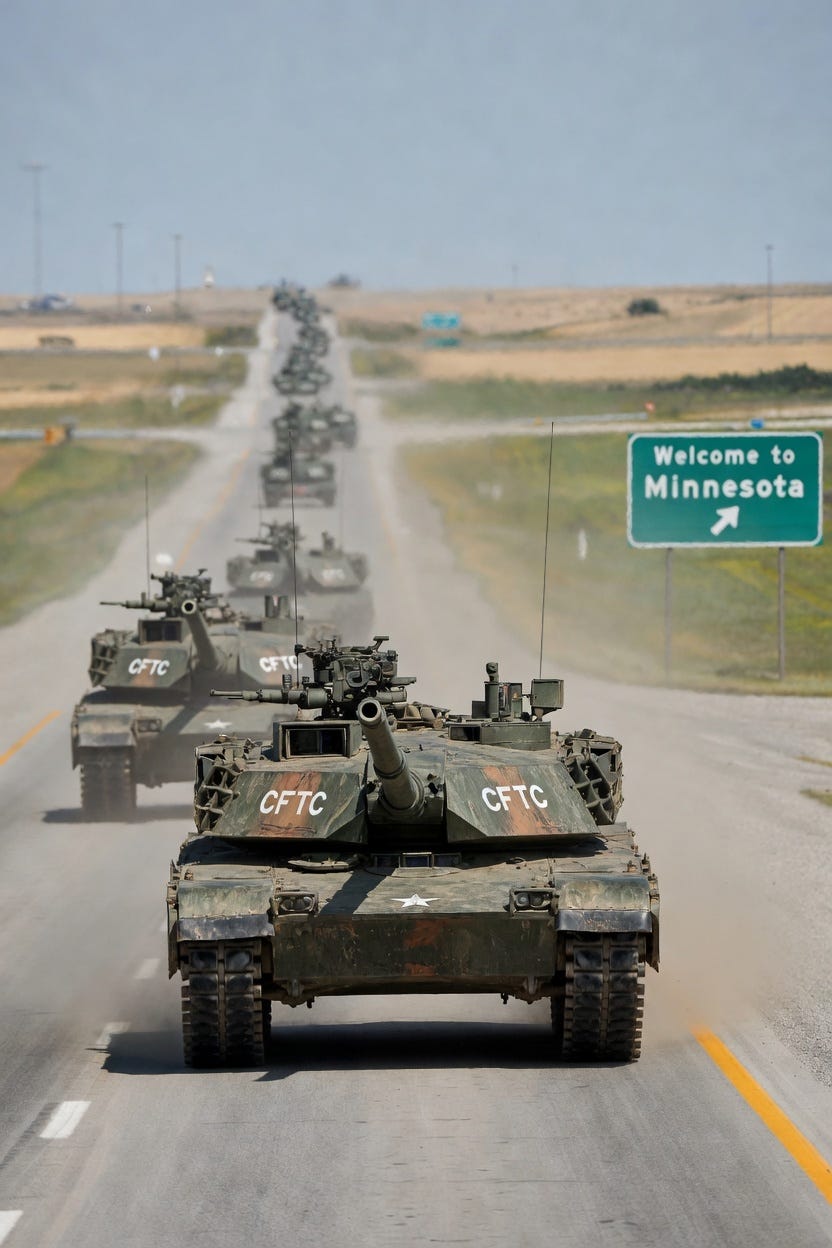
Many prediction market experts expect that the CFTC’s lawsuit will be a walk in the park.
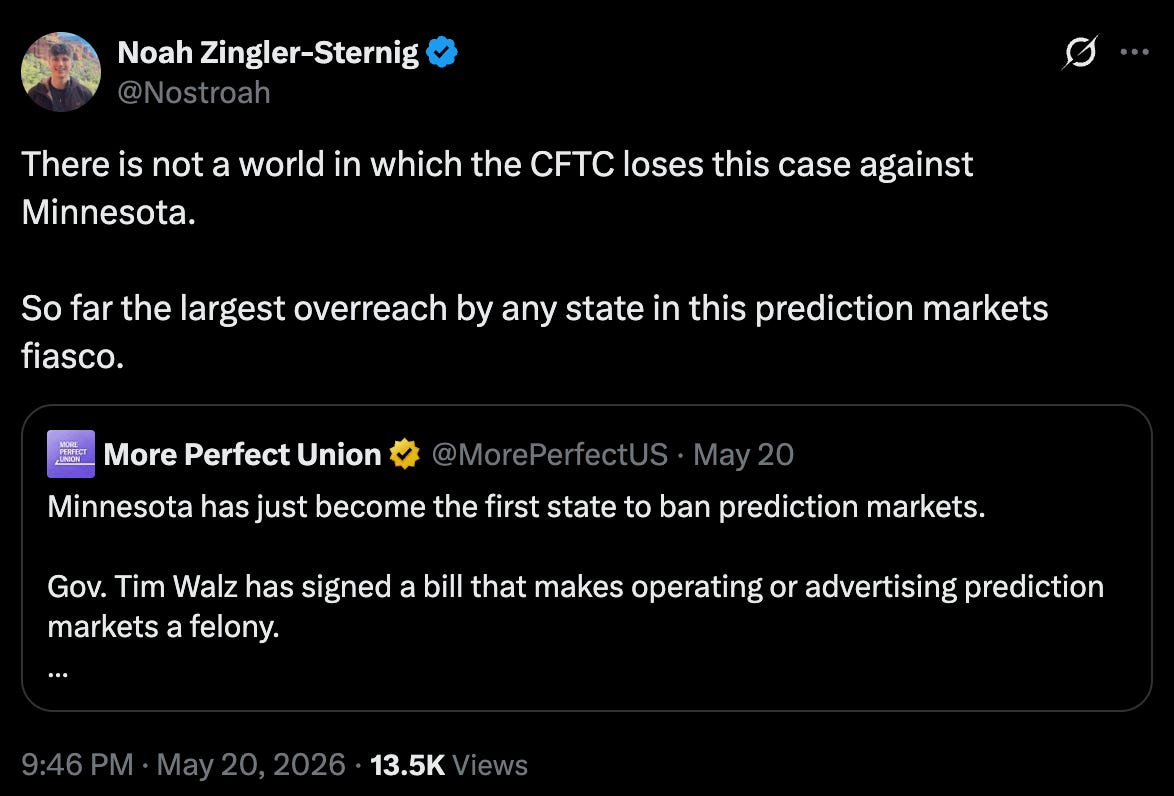
The logic behind this is straightforward. States like Nevada and Arizona are trying to simply ban prediction markets, and they’ve been relatively unsuccessful in their lawsuits so far. Therefore, why should Minnesota, who is not only trying to ban but criminalize prediction markets in a hazily-worded clause of a mega-bill, have any easier of a time in court?
But if it there’s some world in which the CFTC loses, I know a lot of people who are getting banned from the great state of Minnesota.
Every financial market is a prediction market, but most people don’t think about it like that.
See 17 USC Part 38 for the Core Principles of Designated Contract Markets.
I would think that insurance contracts should be called something along the lines of “allowed wagers,” but they actually list insurance contracts under a section called “what are not bets.”
Theoretically at a state level. Augur is not a registered DCM/DCO.
Side note: the state-run lottery is one of the most exploitative taxing mechanisms of all time. States are trying to convince (mostly) lower-class citizens to pay extra taxes using deception. Why is there all this talk about banning prediction markets but none about shutting down MegaMillions?