

More Perfect Union, Less Perfect Facts
An "investigation" into Polymarket is riddled with false info.

Last week, More Perfect Union, a left-wing media company, published a video titled “Polymarket Asked To Work With Us. We Exposed Their Scam Instead.”
While they claimed to be “investigating” Polymarket, the actual video was mostly just a compellingly narrated retelling of all common criticisms of prediction markets.
When The Supercycle investigated the nature of these extortive claims, we found that they were based on mountains of n=1 studies, propaganda, misrepresented data, and sampling errors from hell.1 Below is the complete investigation into MPU’s outlandish claims.
Only around 30 seconds in, the video’s narrator, Trevor Hayes, criticizes Polymarket CEO Shayne Coplan and Kalshi co-founders Luana Lopes Lara and Tarek Mansour for making supposedly false claims about the utility of their respective platforms. They roll a clip of Coplan speaking on 60 Minutes and saying “A diverse group of market participants is more accurate than any given expert.”
The context portrays Coplan in a negative light, and the framing makes the claim seem absolutely preposterous.
In reality, data backs up Coplan’s claim. Studies as far back as the early 2000s, before prediction markets were even somewhat liquid, the Iowa Electronic Markets outperformed polls around 70-75% of the time, according to Berg et al., 2008. Similar studies include Wolfers et al., 2004 and Arrow et al., 2008.
He goes on to explain the basic concept of prediction markets including the design of binary options. He correctly overviews that the price of a contract represents the probability of the event occurring, and even explains, albeit skeptically, that a financial incentive is a filter to separate out signal from noise.
But he immediately proceeds to undermine his recently established credibility by stating that “to get the most accurate predictions, they actually kind of need insider trading.”
In a strongly efficient market, it would theoretically be nearly impossible for a non-insider to make consistent profit. This is clearly not the case. If prediction markets thrived on insiders, there would be no opportunity for “non-informed” traders, who would be systematically losing and therefore exiting the markets, leaving behind degraded liquidity and eliminating the markets altogether. This creates adverse selection, and if this scenario was actually the case it would mean Kalshi wouldn’t be worth $22 billion right now.
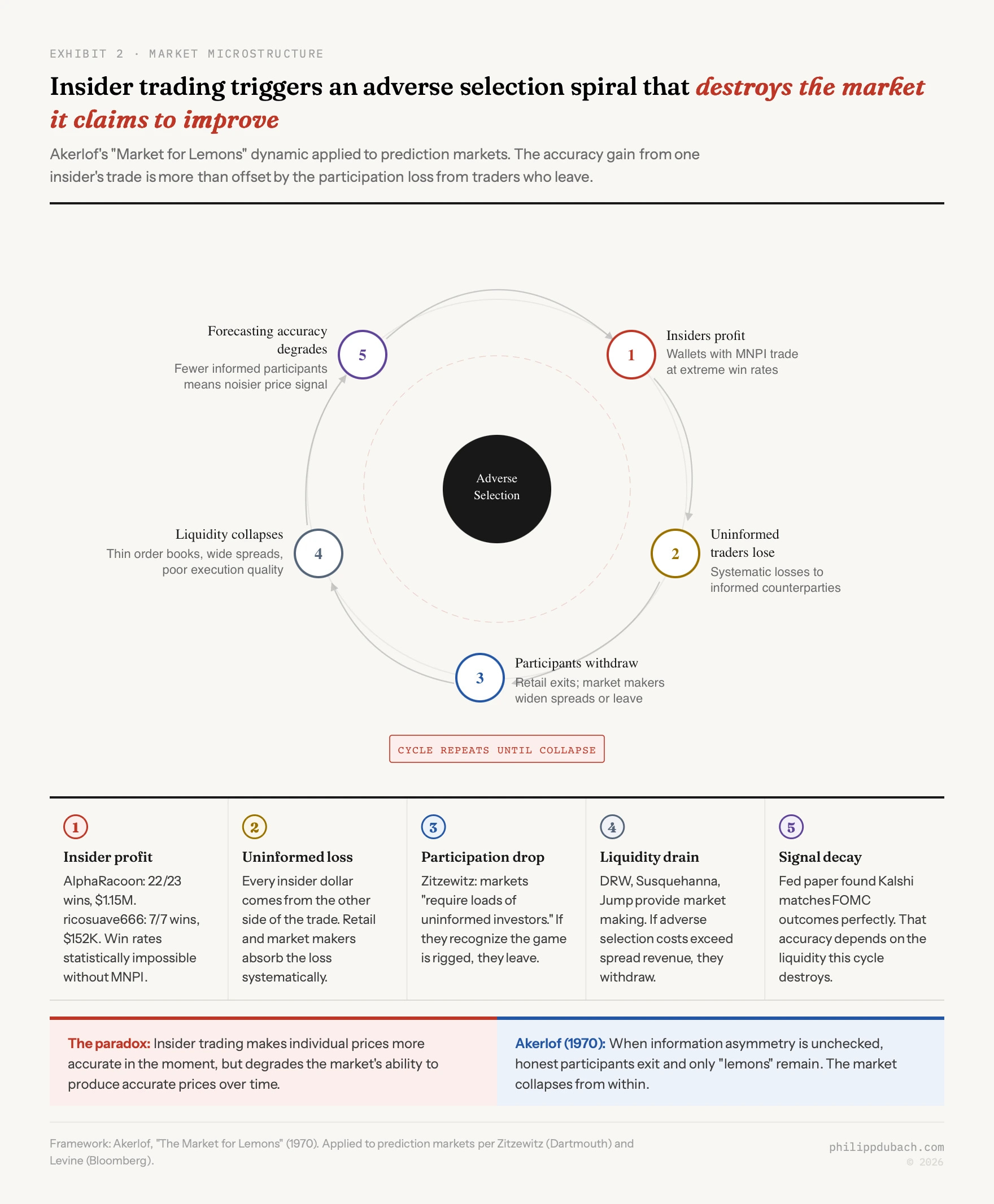
Trevor and Dustin Gouker both state that the exchanges can’t possibly police all of the activity, but that implies that humans are examining every trade, which is impossible at this scale. It’s entirely automated, and with 10-15% of Kalshi’s team devoted to improving market surveillance, the algorithms that are being designed are getting more advanced over time.
They develop these algorithms by running market simulations and changing their models to account for behaviors heavily associated with insiders including:
abnormal trade sizing
abnormal timing
large taker trades
prior trader activity
While these algorithms can’t claim to be perfect, they are certainly better than nothing and they continue to improve over time. MPU (and, I’m sorry to say, Robin Hanson) overstate the necessity of insider trading.2
After pivoting from insider trading, Trevor interjects with “here’s the real kicker: prediction markets aren’t even as accurate as they advertise.” Their main citation for this is a paper written by Vanderbilt University students. The paper claims that prediction markets were hardly more accurate than a coinflip.

As the above comment notes, their methodology focuses on one macro event (the 2024 U.S. election cycle), while masking the n=1 nature behind nearly 2,500 derivative contracts.
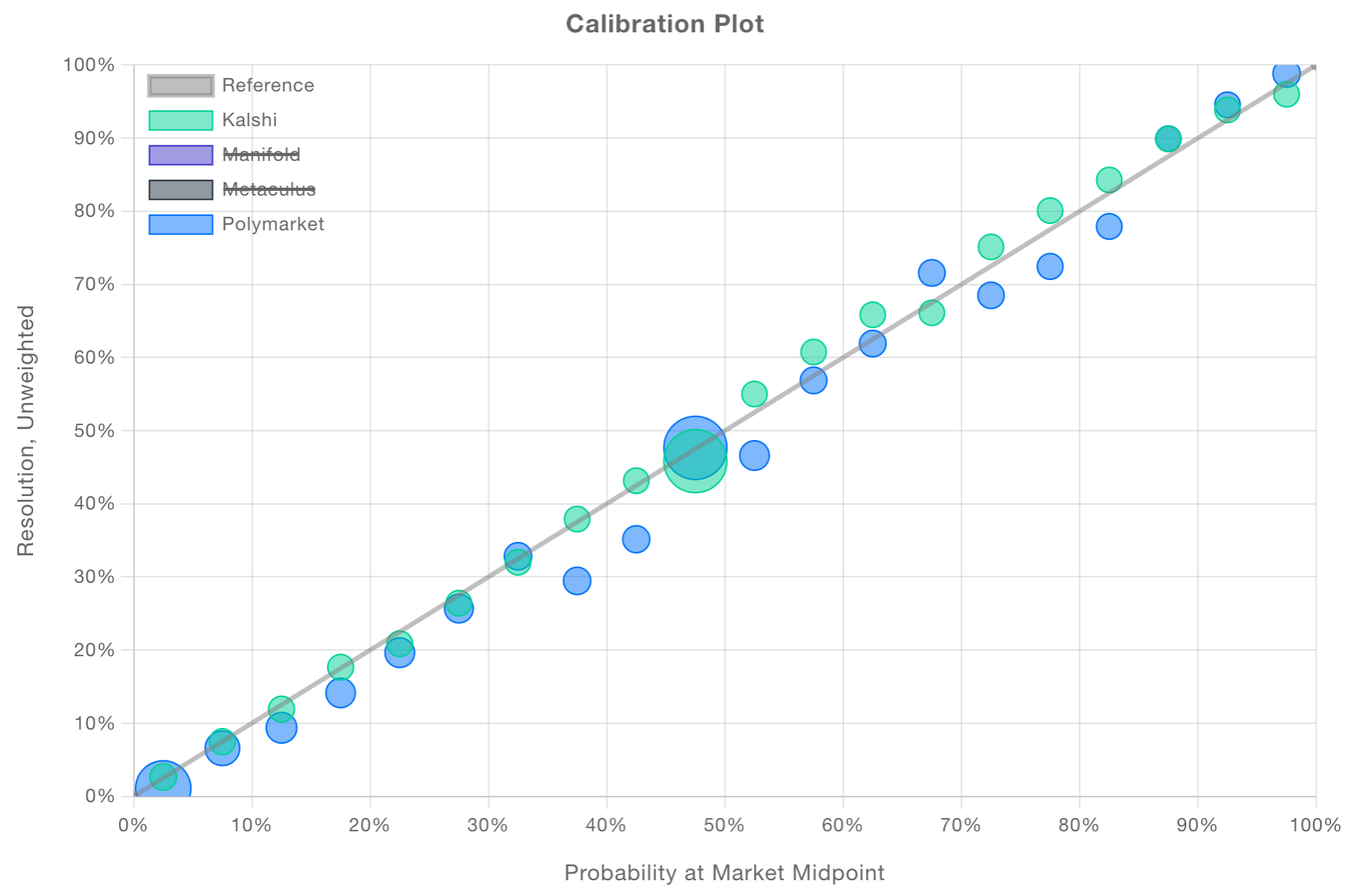
Looking at more accurate data from brier.fyi,3 we see that real-money prediction markets have excellent calibration.
The latter half of the video primarily focuses on Reddit posts by disgruntled and possibly addicted Kalshi traders venting about their substantial losses.
I am not going to downplay this because PM addictions are causing harm to people, but many of these folks would turn to other gambling outposts such as sportsbooks (which are arguably more harmful) or iGaming to satisfy their urge. These people need to get help, but banning these markets all together is not the answer.4
Other quick claims he makes:
Claim: Kalshi does have a house — Kalshi Trading, LLC.
Reality: Kalshi Trading and KalshiEx are entirely different entities that operate in different areas and are not allowed to communicate with each other. Kalshi Trading only exists to supply extra liquidity to the markets, not to become a middleman.
Claim: Sportsbooks have to provide mental health support to addicted participants, but prediction markets don’t.
Reality: Kalshi offers multiple ways to protect the mental health of its market participants, including a partnership with Birches Health to provide a crisis hotline for prediction market traders. There are also ways to set unchangeable trading breaks, self-exclusion periods, and deposit limits.
While I believe MPU was well-intentioned, I wish they had put more thought into where their data was being sourced from and tried to create something that was a more accurate representation of reality.
Prediction markets exist to move us closer to reality. If narratives surrounding them ignore that, we end up moving farther away from the truth.
The standard must be higher. There is no More Perfect Union without a baseline understanding of reality.
Side note: another issue with the insider trading argument is that the same mechanisms exist in hundreds of other asset classes, prediction markets just make it slightly more accessible. But a motivated insider could find other ways to profit from their intel.
Another note: if sports markets were removed this would get rid of the majority of addictions, but more on that in a later post.